0
Ebooks: Turn self-centered features into customer-centric issues

handstandDespite the most ardent protests of sales people (and some marketing directors), the ebook/whitepaper is NOT the place for overt self-promotion of products and services.

Why? (I can’t help but feel like that food guy who always has to explain how to make clarified butter…) Because the goal of your ebook is to establish credibility, a foundation of trust that encourages the reader to pursue a deeper engagement with you. Anything that smells like self-promotion is, well, rotten.

But . . . there must be a way to leverage your unique features in your ebook, right? Yes, there is — you can “flip” each feature into a relevant ebook topic without falling into the self-promotion trap.

Learn how in my new article published recently in White Paper Source:  Do the Flip: How to Turn Product/Service Features Into White Paper Topics.

Continue Reading

Acne Cured the Ebook

Published on January 22 2010 by Jonathan Kranz in eBooks

0

Funny headline I found today via Google Alerts: “Acne Cured the Ebook.”

Who knew zits held so much power? What’s next: “Pimples Pummel Pertussis”?

In any event, if you ever questioned the magic of a misplaced comma, doubt no more.

Continue Reading

0

Metaphors are tricky things — push ‘em too hard and your premise crumbles. But I think the ebook, 7 Infectious Diseases of B2B Marketing, manages its analogies in ways that are both clever and apt. Kathryn Roy, the ebook’s author and principal of Precision Thinking, tells us more about her book and why she wrote it:

I was spurred to write the 7 Infectious Diseases of B2B Marketing because I was working with so many companies that were confident they were doing the right things, the right way — but weren’t. It goes back to that Mark Twain quote: “It ain’t what we don’t know that will hurt us. It’s what we know for sure that just ain’t so.”

Take a look at what is happening with home pages. I have a big issue with what I call, “Sleep Apendea,” in which passionate marketing people try to convey all the messages they think might resonate with their visitors. For example, I see many more B2B websites use Flash video or slide shows to convey complex positioning messages to their visitors. But this assumes visitors will stay engaged as the screen changes. Eye-tracking studies show what really happens: people glance at something on a web page when they detect motion, stay there for 3 – 5 seconds to see if it’s what they’re looking for, and then scan elsewhere on the page. If visitors see too much irrelevant material, they stop reading altogether.

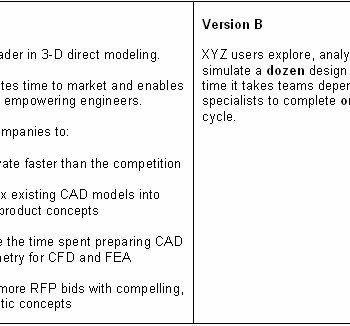
I’m working with clients to streamline what they say to prospects. Here’s one example of a before and after value proposition for a web site:

Roy Chart

In this example, XYZ company wants to claim leadership. But if you check Google Analytics, you’ll find that there aren’t a lot of searches for “3D direct modeling” not related to this company. So XYZ is emphasizing a category that’s based on terms searchers aren’t using. Your home page is just not the place to start educating prospects on what you call the category.

I think that many marketing people, like XYZ, give up before they have found a more powerful and succinct means of communicating their value proposition in terms that prospects understand. I hope that by posting more examples of how we can strengthen our messages, we can get more people to see what is possible and reconsider their own home pages and marketing materials.

Curing Sleep Apendea is no easy task — we’re dealing with addiction. I’m working on a new ebook to share more specific examples.

For more information on marketing cures, you can visit Kathryn at her website, http://www.precisionthinking.com

Continue Reading

NJ applauds Cookbook ebook

Published on November 13 2009 by Jonathan Kranz in blog, eBooks

0

Yesterday, the Star-Ledger and nj.com posted a terrific article about ebooks by guest columnist, Allan Hoffman. Here’s an excerpt from “Free-download publications are a great way to attract attention“:

But let’s face it: If you’re calling something an e-book (rather than a pamphlet, or just a PDF), you’re raising expectations about it. You will want to take a look at successful e-books to see how they’ve blended slick design and meaningful content in order to grab their readers’ attention.

Take the “Taxonomy Folksonomy Cookbook,” a 22-page e-book from Dow Jones Client Solutions (available at solutions.dowjones.com/cookbook/). With illustrations of brightly colored apples, cakes and grapes, the e-book takes on a technical topic — the “metadata” used to “tag” digital information — and approaches it with a fun, friendly attitude. If you’re interested in the material, you’ll read this e-book and think, “Wow, I can’t believe this is free!”

Thank you, Allan!

Continue Reading

7
It’s here: the new Content Marketing Playbook!

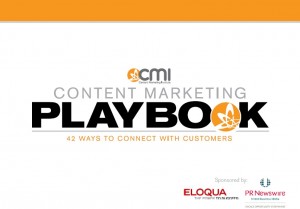
PlaybookAfter months of hard work, it’s a wrap: Joe Pulizzi and I have pulled together the most comprehensive ebook to date on content marketing tactics. It’s the Content Marketing Playbook: 42 Ways to Connect with Customers.

Packed with its pages? Short-form content like articles, case studies and testimonials. Long-form content such as white papers, ebooks and digital magazine. Multimedia content such as podcasts, video and mobile applications. And, of course, much, much more.

Each page offers a fresh content tactic with an illustrated example from real life, suggestions for who should use it (and who should not), and 3 key play points to help you get a handle on the execution. It’s free and it’s ungated. Download the Content Marketing Playbook here.

Continue Reading

1
Guest Post: B2B Email Best Practices eBook

Galen Web Headshot[1]You know I like a good ebook — and when I find one, I like to spread the word. Galen De Young of  Proteus B2B has put together an excellent ebook about integrating B2B email with other email efforts. I’ve invited him to talk about his book, and his ideas, here:

Email marketing continues to be a popular tactic for B2B marketers. A March 2009 report by MarketingProfs and Forrester noted that 39% of B2B marketers planned to increase their spending on email marketing.

There are several reasons for continuing to shift budgets to email marketing. Email marketing is significantly cheaper than other forms of outbound marketing. It also gives B2B marketers the ability to quickly and efficiently segment their markets and deliver tailored messages to each segment.

When looking around for sources of advice and best practices on B2B email marketing, however, we found many articles and blog posts about best practices and strategies, but we couldn’t find a comprehensive single source on best practices. So we decided to create one.

In late August, Proteus B2B released a 58-page eBook on B2B Email Marketing Best Practices. The book contains more than 130 best practices, tips, and strategies for B2B email marketing. The first part of the eBook address many best practices germane to both B2C and B2B email marketing. As you progress through the eBook, however, you’ll find more and more issues specifically focused on B2B. You can download a section of the eBook without registration, or download the entire eBook by registering.

While the eBook’s content is substantial, it’s designed in such a way to quickly review each insight. B2B sales lead consultant Mac McIntosh said, “…after spending less than an hour to quickly skim through B2B Email Marketing Best Practices, I came away with seven ideas I intend to put to work right away to get better results from my own, and my clients’, B2B email campaigns.”

Although the eBook is designed to deliver bite-size information, I think the key is how you put it all together, how you integrate these good B2B email marketing practices and leverage those efforts with search marketing and social media.

At Proteus B2B, our marketing consultants too often see silos of responsibility—one for email marketing, one of search marketing, and one for social media—with little practical integration or synergy. Even when these responsibilities lie within the same group of people, we see missed opportunity for properly leveraging email content on the web for search, for using social media to drive traffic to email content, and for providing ways for email recipients to easily share email marketing content.

Earlier this year, we wrote a blog post titled, “Are you Optimizing Your Email Marketing for Search?” We noticed more than a few odd comments on Twitter concerning the concept, and one reader commented on our blog, “…content written for e-mail marketing is not intended for search engine optimization, really… it should be a little different than the normal content published on the website.” The truth is most B2B email marketing is content marketing—and most of that content is also publically accessible on the sender’s website. As such, you’re ignoring huge opportunities if you don’t also optimize that content for search.

An article in this month’s BtoB Magazine noted an Association of National Advertisers survey citing 87% of responding marketers said they are challenged with identifying cost savings and reductions. If you read through the eBook on B2B Email Marketing Best Practices, you’ll begin to see how you can do more with less, how you can truly leverage your investment in email marketing if you also begin to consider and coordinate search marketing and social media efforts around the same content.

We know we haven’t thought of everything, and that there are lots of good ideas for B2B email marketing still out there. We’d like to make the recently released eBook a strong resource for B2B email marketers. If you have found other ideas and practices that work really well, please let us know via the comments on our blog.

About Galen De Young

Galen De Young is managing director of Proteus B2B, a marketing consulting firm specializing in repositioning B2B companies and their brands, and Proteus SEO, which specializes exclusively in B2B organic search marketing. He’s a regular columnist for Search Engine Land’s Strictly Business Column, and a periodic contributor to MarketingProfs and My Daily Fix. Galen is a frequent speaker at marketing conferences and events, most recently speaking on B2B SEO at MarketingSherpa’s B2B Summit in San Francisco. He’ll be speaking at the same B2B Summit event in Boston next week.

Continue Reading

Content: Once is not enough

Published on September 21 2009 by Jonathan Kranz in eBooks

0
Content: Once is not enough

Return On Intelligence ebook

If you’re pursuing a content strategy as a means of establishing thought-leadership, encouraging prospect trust and advancing your presence in a given industry, you must remember one thing:

Once isn’t enough.

One article, one case study, one white paper, one ebook will not get you where you want to go. As a tactic, sure, the one-off may help you gather leads and achieve publicity. But as a strategy, content marketing demands repeat effort. Persistence. Sticktoitiveness.

That’s why I’m very pleased that Dow Jones (disclaimer alert — yup, they’re a client of mine) has built on the success of The Taxonomy Folksonomy Cookbook with a number of subsequent ebooks, including The Conversational Corporation and two, brand new ebooks you may want to read:

I know that  The Taxonomy Folksonomy Cookbook put more than 50 qualified leads into the sales pipeline. I’ll ask my contacts how the other books have faired. In the meantime, they’re free for you to download, no registration required.

Continue Reading

2
Guest Post: 5 Management Blunders Causing Sales Impotence

John FoxAs his name suggests, John Fox has a sly and savvy take on all things sales — especially when it comes to getting more impact from your sales team. Today, he talks about his new ebook, 5 Management Blunders Causing Sales Impotence: why he wrote it and what it’s about.

Having spent most of my [egads!] 30+ year career working for and with fast-growing, small businesses, I’ve gotten an opportunity to witness revenue-generation like few others. I’ve participated in it, created it, nurtured it and mostly, fed it. It’s been a terrific ride, one that began when Intel punched my train ticket in 1979.

But saying all that, I also know the dark side of small business leadership. Regardless of management’s experience and formal education, somewhere along the line, the fundamentals have been forgotten, especially those related to the alignment of the entire company behind the sales people who make the top-line possible. And let’s remember, without a top-line, you have no bottom-line.

In some ways, it’s almost silly to believe that companies actually expect their top sales talent to do things that are way outside their comfort zone, to say nothing of things that are beyond their skill set. When executives expect sales reps to do tasks that literally prevent them from spending more time with prospects and customers, and then curse these same sales reps for missing quota, you have to wonder what planet management came from.

For example, when companies obligate sales people to enter copious notes into Salesforce.com contact records — a task that easily eats up an hour a day (12%) — you have to wonder about the value of those notes. For a sales rep carrying a $2M quota, those almighty notes have an implied cost of $250k. Seems to me, adding a secretary to the office (or some speech-to-text technology) would make much better financial sense.

Now in this example, I’m not saying all notes are unnecessary, just most of them. With a little effort, most sales calls could be summarized with exceptionally simple, standardized checkbox forms.

It’s this dark side that I want to expose. For it is the dark side that’s causing sales reps to be revenue-impotent. And while there’s no “blue pill” to bring an immediate “fix,” there are a few very simple things the leadership team can (and must) do begin the process of turning things around.

About John Fox:

John is president and founder of Venture Marketing. He has extensive hands-on experience as an entrepreneur and C-level new business developer for technology–enabled businesses. John has led the launch or re-launch of 44 companies, resulting in double and triple-digit growth for every client served.

5-management-blunders-3d-cover-600pxYou may download the ebook, 5 Management Blunders Causing Sales Impotence, here!

Continue Reading

2

I’m pleased to announce the release of a new and improved ebook on case studies: Making Your Case: Everything You and Your Colleagues Need to Write Compelling, Lead-Generating Case Studies

Okay, in all honesty, this isn’t new. But when I first released it, the design sucked. I know, because I “designed” it. Now it’s been reworked by the same brilliant team that designed The eBook eBook, Ciano Design.

The ebook not only includes the how-to information you’d expect, but adds some handy extras including:

  • Convenient worksheets for developing the three sections of the case study
  • Special insights on writing case study headlines and subheads
  • Links to three supporting videos on case study related issues

Enjoy. Share. Spread the word. Thanks!

Continue Reading

2

We all get stuck from time to time. Here a few ways to break the creative logjam:

1) Work backward: Think of a recent client/customer success story — what did you do to help the client achieve goals or overcome obstacles? The answer could form an expanded case study or a how-to primer.

2) And the survey says…: Got a decent house email list? Instead of hitting them with another promotional blast, invite them to participate in a survey on relevant industry trends and issues. The results can be the core of an ebook you can supplement with your advice/recommendations.

3) Follow the leader: A leader in your own organization, that is. Do you have someone on hand who’s getting traction with blogs, webinars and speaking gigs? Consider featuring her in an ebook that amplifies her ideas and can be shared with her growing audience.

4) Do a 180 with your corporate capabilities brochure: You’ve larded your brochure with “about us” copy. That’s bad. But you may be able to flip the same content into “about you” messages by shifting the perspective. That’s good. Instead of writing about what you do, write about what they can/should do (following your brilliant ideas, of course).

5) Recycle your content: Go back over your blogs, articles and press releases. Chances are, you can assemble a solid ebook from the multiple “spare parts” you have on hand.

One last thing to consider: good writers should be able to brainstorm with you to help you come up with appropriate ebook ideas you can fulfill. When in doubt, give them a call.

Continue Reading